A to Z of Making It, Copyright, Music, My Stories, Piracy, Stupidity, Treating Fans Like Shit

The Billions Artists Don’t Get But Should

This is the world that the artists have created when they signed away their masters and Copyrights to a record label. And for this tragedy to be fixed, the artists need to understand that it starts with them.

The labels have been the recording music gatekeepers for decades and they had full control to sign artists to contracts with less favourable terms.

In the process, the labels amassed a catalogue of music which gave them negotiating power at the table and when it came to take overs or selling off parts of the label, these profitable back catalogues bring in a lot of money.

French entertainment giant Vivendi owns Universal Music Group (UMG). Now Chinese tech company Tencent is looking at a 10% stake in UMG worth up to $3.6 billion dollars. The worth of that stake is because of the artists and the works UMG holds on behalf of the artists; works which they more or less paid a pittance for and works which have probably really recouped 100 times over.

How much of those billions would go back to the artists?

But hey, artists instead are forming a lobby group to fight against the tech lobby groups in the U.S. Because the distributor is now a problem. This is the same as the artists forming a lobby group in the past to fight against the truck drivers and the record stores.

I’m all for more power to the artist. It’s the artist that creates the song which connects with audiences and makes dollars. But for the artist to also have a fair say, they need to lobby hard against their employers (if they have a label deal) and the publishers, because these organisations make billions from the deals they organise with streaming companies and by selling off their small stake in the company.

And going back to the Music Artists Coalition (MAC), which also includes high profile managers, I don’t see how they will advocate for the 98% of artists doing it tough, when they represent the 2%.

But it’s a start.

Will MAC get back the masters from the labels. Oh, wait, most of those masters got destroyed in a Universal Warehouse fire.

We’ll lucky for the Public, that there is a copy of the music online. Otherwise, the tunes would be lost forever, in peoples records collections, which either end up in the trash or in a second hand book shop.

Because the labels don’t really care about this history. If they did, they would have stored the masters better, in a climate controlled room instead of a basic warehouse and they would have stored the back-ups at a different location instead of the same building.

All the labels care about is the free Spotify and YouTube users and those users who “stream rip”.

The labels (with their lobby groups) have court granted blocking on their side in most countries, so visits to sites like The Pirate Bay have reduced. However, fans of music just use YouTube and the free tier of Spotify to access music (which are both legal) and the labels don’t like it, because they are unable to find a way to convert the users of the free tiers to paying subscribers, especially in Italy.

So in this case, the labels cant increase the price to access music because people are not paying the current price as it is. So the price needs to come down. But the labels don’t want that. The option they want is to cut off the free-tiers, however this will just drive people back to the pirate sites.

And if the price to stream in Italy comes down, the record labels need to be reasonable here and still pay the artists their fair share, but we know that the words fair and reasonable are not associated with the labels.

Standard
A to Z of Making It, Copyright, Music, My Stories, Piracy

Compensating Artists

Social media connects artists to fans. And that is a good thing.

The issue is that a lot of artists use social media as a one way street to market themselves and push their product. But for people to invest in you, you need to connect with them, and there are artists who do it better than others.

Dee Snider comes to mind immediately as one who does a great job connecting with fans. Dave Mustaine and Sebastian Bach do a good job as well, while Robb Flynn and Nikki Sixx do a fantastic job. Another artist who has two way comms going is Corey Taylor. There are a lot more, I know and I follow quite a few.

A simple question from a Depressed Reds Fan user account to Corey Taylor on Twitter got me interested;

“Just curious, where does the main source of income come from? I’d assume touring and merchandise, but I really don’t know.”

Corey Taylor responded with the following;

“We HAVE to tour. It’s the only way we can make a living. Merch helps, but the merch companies make the lion’s share. Streaming is pricing artists – old AND new – out of careers.”

Another user “Rock Feed” added that;

“People have this idea that bands are filthy rich. Royalties are so low for bands once all the suits get their take.”

And this started a conversation from the fans about what they try to do as consumers to make it profitable for the artist they support to earn a decent wage and continue creating music.

But, in order to fix the argument about streaming payments or digital payments or how the artist can be compensated, there needs to be a line drawn in the sand, because it is NOT THE CONSUMERS FAULT.

As consumers, we stream, we buy, we go to the shows, we buy the merch and we buy the collector’s edition.

How much more can the consumer do?

Of course, according to the record labels, we should pay more for streaming. Because if we did, more royalties would go to the artists which is all BS. The royalties going to the artist would be the same regardless of what the streaming rate is.

What about the record labels paying more to the artists in royalties?

Then you have the government controlling the rate of payments, which means, music doesn’t operate in a free market, instead it operates in a government granted monopoly.

And Publishers make billions for doing really nothing and pay out nothing because hey, it’s the consumers fault and the streaming companies fault according to them.

Other posts from other artists got screen shotted and re-tweeted.

James Blunt said he got paid 00.0004499368 pounds per stream. Beers are on him. Another user jumped on that and did the math that 1,000,000 streams of a song = 440 pounds. And when you split that amongst band members it doesn’t add up to a lot.

Another user called Source Code tweeted that they read;

“The Who back in the 70’s started a tour 40K in debt. They had a very successful time but afterwards the band were told they were still 40K in debt. It wasn’t the drinking or smashing up equipment that cost them, it was the anonymous greedy suits stealing.”

Corey Taylor re-added that;

“Musicians are LITERALLY the last to be paid”.

And that is true.

Artists are paid once all the expenses are paid. That advance payment has to be recouped. Studio time and promotion needs to be recouped. Legal needs to be paid and Management needs to be paid. Somewhere in between, the digital service provider takes up to 30% of the royalty paid. The label takes the rest and then distributes what the contact states to the artist. Then you have the publishers. Same deal there. The digital service provider takes up to 30% and the publisher takes the rest, distributing the money according to the contract they have with the artist. If the artist sells vinyl and product, they get a higher rate once the monies are recouped.

You know when you see articles like Steve Perry signing a publishing agreement or Nikki Sixx signing a publishing agreement and you can interchange any other artist who has a valuable back catalogue into the phrase.

Well, those artists don’t sign those agreements and get nothing in return. Obviously they are in a position of power to sign an agreement to their terms and get a favourable royalty rate, but there will be rules that the publisher would pay up front an advance fee and recoup that fee over the term.  

And when artists go out on tour and depending on their pull, they even scalp their own tickets to make more money on the show, because why should the booking agent, the venue, the parking stations and the food places make more than the artist. It’s wrong but legal.

Phil Labonte from All That Remains posted that their biggest song has 67 million views on YouTube and they have over 1.3 million monthly listeners on Spotify but see nothing from it.

Phil further mentioned that the band ends up making between 10 to 15% of gross on a tour. Then they need to split that amount 5 ways and pay their taxes. Once that is don’t, they can start paying their bills.

Bigger bands, will take an upfront payment and then negotiate this per show split afterwards.

But for a smaller band, if they have a show that has 1000 people at $20 a ticket, then that is $20,000 in gross earnings. Based on Phil’s numbers, the band stands to make between $2K to $3K for the show. Split 5 ways, it’s $400 to $600 per person. Play 20 shows and if you get the same crowds, then that’s $8K to $12K per person. Gross. Then tax.

And by the end of all the conversations, the artists didn’t care how people got the music, they just wanted to be compensated.

But music operates in a government granted bubble, and not a free market price, so the prices set are relient on Copyright rules (created by the Government) to make up the difference.

Artists tried “pay as you want” bundles (which is a way to test what the free market would pay for your work) and I don’t see too many of those bundles on offer today.

And there was two way communications between Corey and fans, who said, that since Corey plays music in a genre which isn’t popular, how can he expect to make coin on royalties to which Corey replied back with that he doesn’t believe that is the case, as all of the shows sell out and the genre is popular to the masses.

Its back to the same old argument; metal fans don’t stream as much as pop fans. And as an artist, do you want your fans to buy your album or stream it or both.

The best part of all of the conversations was the comment from Corey which said;

“As long as the RECORD LABELS get THEIR money, they don’t CARE if the ARTIST gets paid at ALL. Or who plays their music – unless it’s a critic on YouTube, THEN THEY’RE UP IN ARMS.”

So much truth there. The bottom line is this; the Record Labels own a stake in Spotify. And they own this stake, because they had negotiating power from all the Copyrights they held, who really should be owned by the artists.

Did anyone notice that Tool recently entered the world of streaming?

And they would have done it on their terms, and their own rate. And they will be well compensated.

Standard
Copyright, Music, My Stories, Piracy, Stupidity, Treating Fans Like Shit

Copyright For Nothing And The Chicks For Free

Reading copyright stories elicits two responses from me. The “Are you freaking kidding me?” response and the “This is stupid” response.

The mighty Meatloaf along with writer , Jim Steinman (who is credited as the songwriter) had a copyright spat on their hands for “I’d Do Anything for Love (But I Won’t Do That)”.

An artist called Jon Dunmore Sinclair claimed he wrote the song and Meat Loaf along with Steinman, stole it. Mmm, I am sure Mr Sinclair, still had possession of the song he wrote and it wasn’t stolen, but hey, let’s associate stealing with copyright infringement as well. Oh, wait, it already is associated, because the record labels have done a great PR job convincing people that accessing music illegally is stealing.

The story goes that Jim Steinman and Jon Sinclair had the same attorney, and via this attorney, is how Steinman heard Sinclair’s song called “(I’d Do) Anything For You”. Meatloaf argued that having a similar lyrical phrase is not copyright infringement, however without having access to hear Sinclair’s song, it’s hard to tell.

Meatloaf settled out of court, while Kate Perry and her team went to court and lost.

Now this one is a complete, “what the!, how stupid is that?” verdict.

You see, in this case, an artist called Marcus Gray (who uses the name Flame) claims that Perry ripped off his beat, and a small musical pattern.

These kind of claims trouble me, because the person claiming to be ripped off is stating that their work is so original and free from influence and not inspired by anything else that came before it. But people should check out this Vox article which shows how similar Flame’s Christian rap song is to another song back in 1983.

But hey, while Perry and her team relied on telling the story of how the song was created, Flame (original name as well) relied on pseudo gurus in musicologists to prove that they are similar. And the court agreed with the musicologists.

Which brings me to the next troubling issue, judges and juries changing the intent for what Copyright is meant to be. Then again, the labels have created this litigious monster themselves when they lobbied hard to get Copyright terms extended to life of the artists plus 70 years.

These kind of cases really started when the heirs of artists started suing.

And for the record, this never should have been an issue. If Kate Perry ripped off Flame then Van Halen can claim to be ripped off as well for “Why Can’t This Be Love”, because they have a C to B note transition. Throw in every other artist who has a song with a musical bar passage which goes from C to B in a staccato way. As Dr Luke (one of the writers) said on the stands), its basic building blocks. It’s like saying a writer can’t use the words “the”, “a” or “and”.

Standard
A to Z of Making It, Copyright, Music, My Stories, Stupidity

Copyright And Hell

When I was writing this post I was listening to “Heaven And Hell” from Black Sabbath, so “Copyright And Hell” felt right for a title. Because when you start to get into the Copyright World, it’s hell.

So here we go on another post about Copyright absurdity in the music business. If I start including the art world, the photography world and so forth, I’ll never be able to finish a post.

YouTube has finally changed its content claim system, which now puts onus on the copyright holder to prove which section of the video broke Copyright laws.

In case you didn’t know, Copyright claimants had it all in their favour and they used this power to censor YouTube videos.

If you want to know what kind of a mess it became, a video of bird calls and white noise had takedown notices sent to it. Other videos that used 5 seconds or less of music as part of a news story or comedy routine (which is fair use) got taken down.

And every one wants a piece of the pie.

Here’s a lawsuit from a Christian rapper who claims that Kate Perry stole his beat. Yep, people are claiming beats as copyrightable. I guess when you move into a pop world which is all about beats and vocals and no music, suddenly everyone who creates a beat (either using a live drummer or samples) has a case.

Even insurers are caught in the crossfire. A rapper took out an insurance policy which covered any liabilities related to their professional music career. The rapper was involved in a copyright dispute which incurred costs. He asked the insurance company to pay, and the insurance company said no, accusing the rapper of withholding important information when purchasing his insurance policy. And now the rapper is suing the insurance company for not paying. And both will have spent more dollars fighting each other than paying the bill.

But each time I do these posts, there is a story about Copyright which defies the logic of fantasy fiction.

The issue that Taylor Swift has with a competitor manager buying out her old label is old news today. But two weeks ago and for a 48 hour period it blew up in my Google Alert Copyright feed.

It just goes to show how quickly content becomes irrelevant in the internet age. So when you spend 12 months perfecting that album, remember that it could be hot for a week or two and then crickets.

So, an artist writes a song, records it and they release it as DIY and they own the publishing and the masters.

But if the artist signs a deal, writes a song, spends the money advanced to them to record it and then spends more money of the advance to release and market it, well the label owns the master recording for a very long time and the artist still has their publishing rights as the songwriter.

If the songs make no money, the label wouldn’t care much about them, but they still wouldn’t let go of the masters easily, just in case those songs make millions later.

However if the songs make millions, then the label has a good income stream and they would fight tooth and nail to keep those masters. Which is ridiculous, especially when Universal kept it secret that a fire at one of their storage facilities wiped out the Masters of some of the greatest albums. And the back up Masters Universal made got placed in the same facility, next to the original Masters. In other words, the labels don’t care about the Masters, because if they did, they wouldn’t have burned like that.

In relation to Big Machine (Swift’s Old label), 80% of its income came from Taylor Swift’s catalogue of songs. So it’s selling point to any buyer is that catalogue.

So what say does the creator have about who buys their most profitable work, the songs which made them popular?

John Lennon and Paul McCartney got a buyout back in the day before the owner of their songs ended up changing hands so many times that eventually Michael Jackson (realizing how the recording business works) purchased them.

Well if you are a creator and you sign a basic deal, you basically have no say whatsoever in who owns the master copyrights to your songs. However if you had the negotiating power, you can add these terms into your contracts. But in most cases it’s stacked against the artist.

The best advice is to build your brand so it’s strong enough to negotiate in your favour, so you own your masters and your publishing when the label comes calling.

But everyone is tempted by money and the patience and discipline is hard to maintain.

Standard
Copyright, Music, My Stories, Stupidity, Treating Fans Like Shit

Spotify

It always happens, when the saviour, the good one, the one with actual good intentions, the one who is trying to bring balance ends up being like the ones that came before it.  

How much more privacy can people give up, when every time we deal with a corporate entity online, we end up sacrificing our personal details to gain access?

Deal with Facebook, you give them access to everything. Deal with Apple and their store, same thing happens. Same with Amazon, Google, Snapchat and so on. Basically any organisation you deal with online will take some personal detail. Which is okay if you want to transact with them but then those personal details will then be sold and given to third parties for years on end making those organizations billions from our data and habits.

The Verge has a story about pre-saving albums on Spotify and when this happens the labels get access to our emails and any other permission which they request. Sony wants a lot, while Universal and Warner Music Group want less, but all of them involve getting permissions to users private playlists, date of births and what not.

It’s not illegal what Spotify and the labels are doing, however it doesn’t mean it’s right. If anyone should be given data on Spotify users, it’s the artists themselves. They are the ones creating the songs, forming the connections with the audience and bringing money in to Spotify and the labels. Then again, the city the listeners are from and how many listens have come from each city should be enough data for any artist to plan what comes next.

If you are an independent artist with a core audience, there is a high chance you would be all over this kind of data because you know its key to your career to satisfy and grow this audience. Obviously a larger artist would care about this data but wouldn’t have the time to deal with it because their enablers will be keeping them busy. If the artist is making money, they are also making money.

And the issue isn’t because private data is being shared. The issue here is that the labels want to control it and make changes to it as they see fit.

But the firing line just doesn’t stop for Spotify. Pitchfork has a story about how Spotify settled a few infringement cases privately and nothing will be disclosed about those settlements. It’s the same subterfuge employed by the labels, but hey, when you give the labels a stake in your business, what do you expect would happen.

Standard
Copyright, Music, My Stories, Stupidity, Treating Fans Like Shit

Gaming The Charts and Losing The Masters

Any person involved within the recording industry and the music industry overall, is looking to make money from the hard work of an artist. Especially an artist who has tunes which make some coin.

And the record labels, well they are even looking at making money in any way they can for doing even less then what they did before.

I’m not sure if people have realised, but depending on the artist, there is a high chance that you might have purchased a concert ticket which included a free download of the most recent album of the artist. You see, artists and the labels alike, still think the charts matter and that a platinum record hanging up on someone’s wall is super important.

Bon Jovi and Metallica are two artists that come to mind quickly who have done ticket/album bundles.

And concert promoters don’t like these bundles. The fan is unable to say no, and since the price of the concert ticket looks to be the same, they are thinking free album.

But ticket pricing is a tough gig. If the price is too low, the show sells out and the scalpers along with the reselling market make the money because of the demand.

If the price is too high, then the show is at risk of not selling out and the money lost is carried by the promoter who is taking the risk. And when it comes to bundles, the labels just want the promoters to add extra dollars to the tickets. But, if the promoters thought the tickets would sell for $5 more, the tickets would be sold at that price.

So the $5 album charge comes out as a tax against the show takings. If you are like Bon Jovi and you get 20,000 people to your show, the show’s takings will need to pay $100K to the record label. Do 30 shows in the tour with the same numbers and that’s $3 million, the record labels get and as a byproduct the artist gets a platinum record on their wall.

And the label didn’t spend a cent on marketing but still made a cool $3 million in album sales, because of the hard work done by others on the road.

So if the money comes out of the concert takings, who is actually paying for the albums. Basically, the cost is absorbed by the artists , who are actually buying their own albums.

There is a great blog post over at Bob Lefsetz about it.

Then you have the pop artists who have all agreed to have T-Shirt and Album bundles, beanie and album bundles and so forth. If you don’t, believe me, check out the story over at the NY Times.

Gaming the system, are they….

The article states that from the 39 album releases that went to number 1 with a bullet last year, half of them had a concert ticket or clothing bundle attached to the sale. One artist, sold album bundles with key chains, hats and tickets. Another artist had the album bundled with energy drinks.

Bon Jovi is also mentioned in the story, about how their 12 month old album returned to the top of the charts in 2018 because of a concert ticket/album bundle and how the following week it more or less disappeared from the charts.

And maybe if the record labels cared about keeping the masters of some of the best music safe instead of gaming the system, the masters of some of the most popular recordings wouldn’t be lost.

Universal Music didn’t care enough to keep the masters of the recordings safe, and they got destroyed in a fire. I suppose the New York Times article, “The Day The Music Burned” sums it all up.

And talk about a cover up.

The fire happened in 2008 and finally, we are getting to hear about the lost Vault recordings. Even the acts weren’t aware. Acts like Chuck Berry, B.B. King, Cat Stevens, Elton John, Lynyrd Skynyrd, Eric Clapton, the Eagles, Don Henley, Aerosmith, Steely Dan, Iggy Pop, Tom Petty and the Heartbreakers, the Police, Sting, R.E.M., Sonic Youth, No Doubt, Nine Inch Nails, Nirvana, Soundgarden, Hole, Beck, Sheryl Crow and Eminem.

From reading the articles, it looks like any artist who released on Geffen Records, has no original masters, unless the artist had never handed the master tapes over to the label or took the masters back at a particular point in time. When you look at hard rock and heavy metal, we are talking about big artists like Guns N Roses, Whitesnake and Aerosmith who had released career defining albums on Geffen. Add to that list acts like Y&T, Pride and Glory, Blue Murder, Black N Blue, Galactic Cowboys, Asia, Coverdale/Page, Nelson, Salty Dog, Tesla, Sammy Hagar, Tyketto and Junkyard.

So are all the remastered editions coming out recently, really remastered from the original source tapes. Because Universal hasn’t come clean on what has been lost. And when artists were questioned on Twitter by their fans, if their masters were safe, they either answered “no” or “I don’t know”.

But hey, piracy is still the issue.

Standard
A to Z of Making It, Copyright, Music, My Stories, Piracy, Stupidity, Treating Fans Like Shit

The Labels Say Infringement Is The Issue. Maybe Not.

The labels still focus on infringement and see that as a big issue. Stream ripping sites are getting a lot of attention right now, especially in Australia.

But the shitty way the labels treat the artists who created valuable art “which is worth something” is not an issue to the labels.

Years ago, the labels went to court against artists like Eminem, David Coverdale and Don Henley concerning digital royalties. The labels always paid low royalties on sales of music CDs and vinyl. However, “licensing” music (once upon a time licensing was for movies or commercials only), offered a higher payout to the artist.

The question the artists wanted to know was how is iTunes treated?

The labels said iTunes is a “sale” like a CD sale and the artist is paid the lower royalty rate.

The artists countered that iTunes is a “license,” like for a commercial, as the labels need to license their music to the tech service for the tech service to sell it. This in turn means the artists are meant to be paid the higher royalty rate of up to to 50%.

In the U.S the labels won at the district court level, while the artists won at the appeals court level.

Now this “sales vs license” scenario was relevant up to about 2011 as newer contracts the labels drew up afterwards avoided this problem. Basically, everything is a sale to the labels even the streams from streaming service all so the labels could rip off artists a little bit more.

Not sure if anyone noticed, but Def Leppard was also caught up in this dispute for years with their label, hence the reason why their music wasn’t on any streaming or digital service for a long time. Def Leppard even refuses to let their label license their music until they sorted out the payment issue.

And the big issue here is that the record labels really owe a lot of money to artists but they still put out lies that infringement is the biggest challenge they face while they go to court against the artists. But they still put out the propaganda that when they ask for longer copyright terms, it’s for the artists, when they ask for stream ripping sites to be taken down, it’s also for the artists. Basically everything the labels do is for the artists, except payments.

Furthermore, all the labels know that their power in the market is based on the content they hold. In this case, it’s the songs they hold on behalf of artists.

So the Copyright Act in the U.S gives creators the right to terminate a copyright grant they have given to a corporation after a 35-year period.

And of course there are a lot of artists who created works which ended up becoming very valuable, who want to reclaim their copyrights.

Basically artists who released music up to 1984 have put in claims to get their works back.

Then it will be 1985 releases and before you know it, the 1990s artists will want to their rights back. And if you grew up in this period, you know that there are a lot of great songs that make a lot of money, which the labels don’t want to lose control of and the artists who want to get those songs back under their control.

But the labels will not let it happen without a fight in the courts.

Universal Music Group (UMG) are going to court to dismiss the termination notices served against it. Sony is also trying the same tactic.

And they are using their own interpretation of the law which could bog down the proceedings for years while lawyers argue words in the Act and how they can be interpreted.

And the big thing the labels are sticking with is the “works for hire” principle which worked a treat for the movie studios.

Basically if an employee creates something as a work for hire, it means the employer is the owner of the work and the work can not be terminated. So the labels are basically saying that the artists are employees, which we all know is bullshit, because I am sure the artists didn’t get monies added to a pension fund or holiday pay and what not.

Also when the artist wrote that hit song, it wasn’t because they were an employee of the label, it was because they had an idea, either at band practice, or at soundcheck, or in their hotel room or bedroom.

But hey, I guess power corrupts and always wins. It’s time all of the artists started terminating their rights with the corporations.

Standard
Copyright, Derivative Works, Music, My Stories, Stupidity, Treating Fans Like Shit

In Copyright We Invest

Music makes money because people form their own unique connection to a melody, a riff, a beat or a lyric. It’s personal and each connection is different. As a by product of this connection, we spend money on music. And when the ‘we’ in the equation is over 200 million people worldwide, you sort of understand the volume of dollars in play.

And the organizations who hold the rights to popular songs benefit a lot from those songs. Next time you hear “Eye Of The Tiger” from Survivor, there is a pension fund around the world which benefits.

You see the Michigan Pension Funds have invested in a music publishing company called Concord Music which is advertised as “owning” a lot of copyrighted works (like close to 400,000 songs). And when those songs it “owns” are played, Concord gets paid the royalties and the state pension fund benefits. 

But, isn’t Copyright meant to benefit the creator and give them an incentive to create more art. As the article states;

The state initially invested $25 million in Concord Music, and as the investment team got more comfortable, put a total of $1.1 billion into the company. The market value of their investment today is $1.8 billion, representing $700 million in profit.  

If the pension fund made $700 million in profit, how much profit would Concord Music make as the holders/keepers of the Copyright and then how much would go to the creators. Hell the creators can’t even get their rights back under their own control, even though the law states they can after 30 years.

And while all of these dollars from music are going to organizations who contribute nothing to music, CD Baby (another organization) is teaming up with Audible Magic (another organization) to scan the audio artists put up, against its library of 30 million tracks. If the uploaded song matches another track or it has “potentially” copyright-infringing content based on a computer algorithm, then CD Baby can decline to upload the file.

I wonder if CD Baby and Audible Magic are aware that music fans like songs that sound similar to other songs. I can’t even start describing how many songs have an Em, C, G, D chord progression, with melodies which sound similar, so I’m not sure why CD Baby is wasting money they earn from artists to pay an IT company which is looking to be purchased by these kinds of organizations.

And you know that Copyright is out of control when the law suppresses online music teachers, who in most cases teach people for free.

Queue up Warner Music Group, who seem hellbent to takedown everything online and then like all of the other labels, when they are served with termination notices from the artists, they go to court to fight these notices.

But, I am sure the labels would still be pushing the same lines of needing stronger copyright.

Standard
Copyright, Music, My Stories, Stupidity, Treating Fans Like Shit

Ahhh Copyright

Ahh, copyright, you never cease to amaze me and you never seem to be out of the news.

Did you know that in the year or 1999, the profit margins for the labels on music sales was between 4% and 7%, and in 2018, the music profit margins are between 15% and 20%. 

Read Sony’s financials and decide for yourself.

2018 financials.

1999 financials.

1999 is always talked about as that magical year in which record sales hit a peak, and the profit margins in music were less than what they are now.

Since that time, the labels have done nothing in the development of legal online platforms, like the streaming services which include Spotify, Deezer, Apple and YouTube, but they benefit greatly from these services in licensing fees and royalty payments. And their profit margins are better because their music manufacturing costs are lower. It doesn’t cost much to produce a WAV file compared to a vinyl record or a CD, especially, when other techies are developing tools for people to consume music. And the labels have this power because they hold the copyrights for valuable songs, which they refuse to give back to artists, even when the law states, they need to.

But the streaming services are their biggest payer, so the power is shifting from the catalogs to the distribution, as the labels are fearful of pulling their catalogs from their biggest payer.

In all this, stream ripping seems to be the biggest issue to the labels and money needs to be spent to kill this technology. For those who don’t know, stream ripping means creating an mp3 file illegally from playing a song on a legal streaming site. People who pay for streaming accounts, stream rip and people who pay for no content also stream rip.

According to the labels, stream ripping is the fault of everyone else except them. From the labels point of view, the streaming companies should be responsible for monitoring if content is being streamed and ripped at the same time, the ISP’s are to blame for allowing access to websites which provide the software to stream rip and the blame list just goes on and on.

Remember 20 years ago, Napster showed the world, what people would like to do with music and still to this day, no one has figured out a way to make money by giving the people the opportunity, to download music in a format they desire without any digital rights on the track.

Stream ripping is an opportunity to create a new revenue stream. These are users who would like to stream (have access to music) and also be able to take it with them as an mp3, just in case they choose to close their streaming account, which means that all of their content will be lost.

The label heads are probably thinking, why would people need to do this, but hey they do. Fans of music have their own unique way of connecting with music.

A statement always put out there by the labels is that fans of music who stream rip, don’t realise they are also ripping off artists. It’s pretty rich, coming from the labels who have ripped off artists since day dot, and even now, when artists ask for their copyrights back after 30 years, the labels are saying NO and off to court they go.

But hey, everyone else is to blame except the labels. They even want the Governments they bank roll to pass legislation so they can have access to the WHOIS data of websites, so they can track down online pirates.

Should a corporation have access to this kind of address book?

Well if you pay enough money as a lobbyist, anything is possible.

And I know I bash a lot of the labels and their lobby groups, however the techies and ISP’s are not free from blame here either.

ISP’s if they want, can block access to sites on their own accord or in secret agreements with Government institutions or via court orders. However, they also talk the same rhetoric that they have no control for the content their users access.

So should the ISP’s be known as the Online Censorship Police?

ISP’s in Australia and New Zealand, took it upon themselves to block access to sites which had footage of the Christchurch Massacre, which people didn’t really need to see in the first place, however by doing so, the ISP’s have declared that they can police the Internet if they want to, and they have now backed themselves into a corner. You could see the labels and movie studios saying, “well why can’t they block sites which provide access to music and movies, which are not legal sites.”

Anyway if that all fails, the lobby groups of the recording and movie industries want the governments to create laws giving more power to the copyright industries to filter the internet and block websites which they deem to be illegal.

These powers formed part of the Stop Online Piracy Act (SOPA) and PROTECT IP Act (PIPA) acts which got canned after online protests. Obviously, money talks and the music/movie industries are bank rolling a lot of politicians to push their cause.

In Australia, blocking access to sites approved by a court order has led to more than 250,000 innocent sites being taken offline for a certain period of time.

The best solution to any copyright issues is to develop a legal alternative. If people want to share their content, why stop them, let them do it, in an environment you can monetize. If people want to stream rip, let them do it, in an environment you can monetize. From when I can remember, every single person had their own unique way of experiencing music.

Standard
A to Z of Making It, Classic Songs to Be Discovered, Copyright, Derivative Works, Influenced, Music, My Stories, Unsung Heroes

The Record Vault – Annihilator

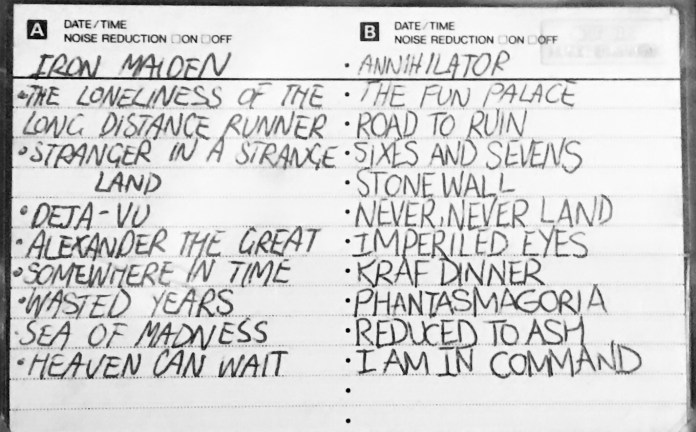
It all started with my cousin, Mega (his nickname was short for Megadeth). He was one of those dudes that just stayed up and taped and taped and taped everything to do with metal and rock music doing the rounds on our local TV stations. One such clip he taped and played me was a song called “Alison Hell”. After he saw that I was interested in it, he told me he had the LP and if I want to copy it off him.

Lucky for me, I had a blank TDK tape handy, so it was a no brainer to get him to copy it.

Since it was a blank tape, I needed to fill up the B side and Mega had a lot of music which I didn’t have. As part of this day together, we also ended up watching the “Shocker” movie and of course, Mega also had the “Shocker” soundtrack on vinyl.

And yes, I was confused with the spelling. The album is called “Alice In Hell” so when I was writing down the track list, my cousin was reading it out to me from the album cover, so when he said “Alison Hell” for song 2, I heard “Alice In Hell” and was about to write that down.

The acoustic guitars of “Crystal-Ann” fills my headspace and the guitar playing technique is excellent and precise. I asked my cousin who the guitarist is and he reads out Jeff Waters from the liner notes. At that stage I’d never heard of him.

By the way, I wasn’t allowed to hold his album covers in case I wrecked em. Actually no one was allowed to touch Mega’s albums except Mega.

Then the evil sounding intro to “Alison Hell” kicks in and when the drums come, you know it’s desk breaking time. And it goes through so many changes and moods before the first verse even starts. To me, this is progressive music. It doesn’t have to be constant time changes, and 50 million notes per bar, which on some occasions is okay, but not all the time. Changes in mood will do the job, and it can all be done in a 4/4 time signature. 

When “Welcome To Your Death” comes in, you get the feeling that Jeff Waters is way ahead of his time in song writing . Not only does he merge the speed and aggression and technical progressive song writing of Megadeth with Slayer, Anthrax, Exodus and Metallica, he also brings in elements of Randy Rhoads and Michael Schenker influences into the mix.

The lyrics and the vocal melodies are not as strong as the artists who had more sales and while people still like to go mental at break neck riffs, their needs to be a message in the words which they can relate to and connect with. 

“Wicked Mystic” is another speed a thon with head banging open string riffs and fast palm muted lines. And that solo, feels like “Over The Mountain” got merged with “Master of Puppets”.

The rest of the album is not as strong as it became too repetitive in the riffs department, with the only light being some cool lead breaks here and there in the songs.

In Australia, we got our music late compared to the rest of the world because of gated releases. I basically heard “Alice In Hell” and the second album, “Never Neverland” in the same year of 1990. However on this day when I was at Mega’s house, I only had one tape with me and it had music on it. On Side 1, was my own Walkman edition of “Somewhere In Time” from Iron Maiden with Side 2 first, and then Side 1. On the second side, I had a mix of Maiden from “The Number of The Beast”, “Piece of Mind” and “Powerslave”. And that was the side which was sacrificed to record “Never, Neverland”.

The difference in production is the first thing you hear. While “Alison Hell” sounded like it was recorded in a garage, “Never, Neverland” had better sonics and a different vocalist. The debut album had Randy Rampage and the second had an unknown called Coburn Pharr, who sounded better. And the reason why Randy Rampage quit the band was to keep his senior role at the shipping docks in North Vancouver.

You see, even back in the 80s/90s artists had to work two jobs to make a living in music, hoping that they will become the 1% of artists which breaks through. A label deal never guaranteed riches. All it did was give an artist an opportunity to participate in the recording business, provided the A&R rep was satisfied with the end output. But it also meant, an artist would have to give up their most valuable asset to the labels to exploit forever.

Another upgrade with this album was the influence of grooves, which Pantera would build a career on and all song writing being done by Jeff Waters, which involved lyrics a person could connect with. 

“The Fun Palace” has a lead break of about 2 minutes which is guitar hero status. And those riffs.

“Road To Ruin” has an interlude, lead section, which blows me away. On the road to ruin with alcoholic speed alright and the song ends with tyres screeching before a smash.

“Sixes And Sevens” has this interlude progressive bit, which hooks me in and when the lead break comes in, Jeff Waters delivers on all levels.

“Stonewall” is another great song, with killer riffs and great lyrics.

“Never, Neverland” has a pretty cool 90 second intro before the verses kick in. And sonically it’s a different song, moving between clean and distorted tones.

The other three albums I have on CD are not available on Spotify Australia which is wrong, but hey, they are all on different labels, like SPV and Music For Nations, so since those companies own the rights, they can do whatever they want with the music.

In saying that, I got “Refresh The Demon” to see what the  band was up to since “Never, Neverland” and I don’t remember a song from it, but it must have been okay, because I purchased “Remains” and was vomiting all over the place when I heard electronic programmed drums and an industrial sound. However in 2002, I gave them another shot with “Waking The Fury” (because the album title reminded me of Yngwie Malmsteen) and I can’t really remember a track from that album either and I haven’t really gone back to the band, except for the first two albums.

And who remembers the CD holder teeth breaking? I only pushed down once and bang they all went.

Standard