
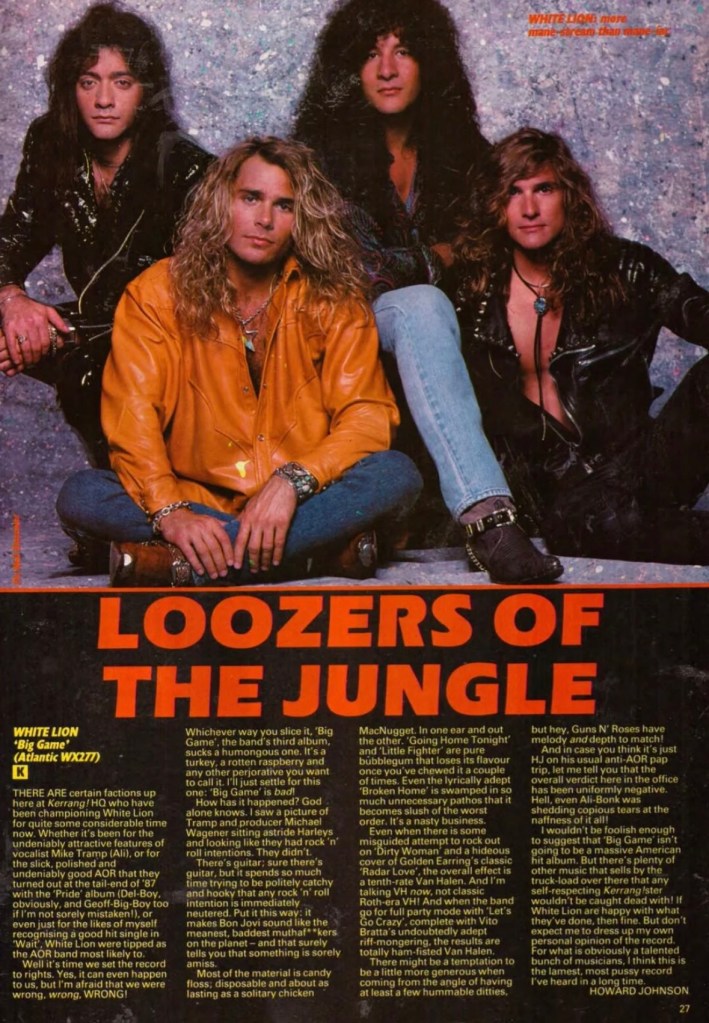
There’s something almost adorable about old rock criticism when you look at it now. Not insightful. Not prophetic. Just… something.
The review of “Big Game” isn’t really about the music. It’s about positioning. It opens by framing factions at “Kerrang!” as if championing White Lion were some kind of cultural crime. That’s the tell. The verdict is written before the riffs are even considered.
This is the late-’80s critic dilemma: if it’s melodic, if it’s polished, if it dares to aim for arenas instead of alleyways, it must be shallow.
Meanwhile, the comparison to Guns N’ Roses floats through the piece like a purity test. As if grit is automatically depth. As if sneer equals substance. It’s a false binary that rock journalism loved to sell. You’re either dangerous or disposable. Pick a side.
But melody is not the enemy of meaning. Craft is not the opposite of authenticity.
The review leans hard into the “sheen” complaint. Arena gloss. Radio ambition. The kind of production that dares to sound expensive. Bands like Van Halen get name-checked like it’s an indictment. As if clarity and scale are somehow moral failings.
Here’s the uncomfortable truth: polish is a decision. In that era, it was architectural. Choruses were built to lift bodies off concrete floors. Guitars were layered to widen emotional impact. That’s not emptiness. That’s intent.
Calling the album “candy floss” is easy. It sounds clever. It’s dismissive in a way that signals superiority.
But where’s the structural breakdown?
Where’s the analysis of chord movement, the dissection of lyrical framing, the conversation about guitar phrasing? There isn’t one. It’s vibe critique. Aesthetic judgment passed off as depth.
And here’s the part critics rarely admit: they’re playing status games too. In 1989, to defend melody-forward hard rock was to risk being seen as uncool. So you preemptively strike. You align yourself with danger. You contrast, you diminish, you posture. It reads less like a musical autopsy and more like someone trying to future-proof their reputation.
Meanwhile, the record just sits there. Unbothered.
Because albums aren’t think pieces. They’re time capsules. They capture aspiration. Big choruses. Wide guitars. Earnest hooks. The desire to connect with more than a hundred sweaty bodies in a club. You can dislike that ambition. But dismissing it because it doesn’t crawl through broken glass? That’s a taste preference, not a universal law.
What’s fascinating is how often history quietly corrects critics. Hooks outlive hot takes. Melodies survive think-pieces. People return to records not because they won debates, but because they felt something when the chorus hit.
You liking this album isn’t contrarian. It’s independent. It means you’re responding to what you hear, not what you were told you should hear. That’s rarer than it sounds.
Critics optimize for the moment. Records optimize for memory.
And memory has a much longer half-life.
P.S
Everybody remembers the mythology of the 80s guitar hero.
The fast fingers. The impossible bends. The solo that feels like a lightning strike. The moment where the guitarist steps forward and the rest of the band becomes scenery.
And on “Big Game”, Vito Bratta is absolutely doing that.
The problem is… guitar hero moments don’t sell millions in records.
Songs do.
That’s the tension at the heart of White Lion’s third album. It arrived after “Pride”, which wasn’t just successful, it was culturally successful. Because it had a crossover song. Not just a metal hit, but a song that escaped the genre gravity well.
“Wait” didn’t succeed because it had the most technical guitar playing. It succeeded because everything in the song lined up: the hook, the melody, the tension in the verses, the lift in the chorus, the MTV rotation. The solo wasn’t the point, it was the emotional payoff.
That’s the thing musicians often get wrong.
Players listen for moments.
Listeners remember songs.
On “Big Game”, Bratta is arguably playing at an even higher level. His phrasing is sophisticated. The tone is surgical. There is genius tucked all over the record, little harmonic turns, fluid legato runs, those violin-like vibrato bends he was famous for.
If you’re a guitarist, it’s a feast.
But the average listener isn’t grading technique. They’re asking a simpler question:
What’s the song I play again tomorrow?
And “Big Game” never quite lands that one undeniable, gravity-defying track. It has good songs. Solid songs. But not the song.
In pop history, the pattern repeats endlessly.
The audience isn’t looking for more complexity. They’re looking for connection.
Listen carefully to his playing and you’ll hear it: he’s not shredding randomly. His solos sing. They’re constructed like vocal lines.
But albums live or die by the three-minute emotional detonations at their center.
“Pride” had one.
“Big Game” had brilliance.
And history shows us which one sells more records.
 destroyerofharmony